Game of Hope
The actual 1799 origin of the Lenormand tradition — Das Spiel der Hoffnung, a German parlour game by Johann Kaspar Hechtel. The 36 cards and numbers still used today.
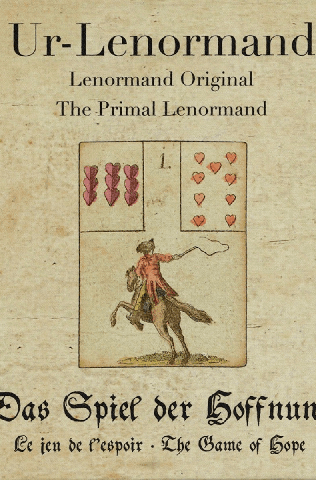
The Game of Hope (Das Spiel der Hoffnung) is the actual original of the Lenormand tradition — a 36-card German parlour game published in 1799 by Johann Kaspar Hechtel of Nuremberg. It was designed as a board game: players moved tokens across a path of numbered cards toward the Anchor (number 35) to win, with each card carrying a small motif and a verse. The fortune-telling tradition came later, in the 1840s, when German printers repurposed Hechtel's cards as a divination deck and attached the famous name Mlle Lenormand to it as a marketing flourish.
Modern reproductions of the Game of Hope let contemporary readers work with the deck in its actual original form — game board and all.
Hechtel's original imagery is small, neat, and resolutely 18th-century — woodblock-style figures and motifs in a restrained palette, with each of the 36 numbered cards carrying its symbol, its number, and a verse. The look is closer to a board-game card than to the chromolithographic prettiness of the late-19th-century Lenormand decks that followed. Reproductions preserve this visual register carefully — the deck is meant to feel period-correct.
The 36 images and their numbers are identical to a modern Lenormand. The differences:
The reading conventions are the same as any traditional Petit Lenormand — combinations, lines, the Grand Tableau all work identically.
Historically-minded readers who want the deck at its actual headwaters, before the fortune-telling tradition reshaped it. Also collectors of cartomancy history, and readers who simply enjoy working with deeply traditional decks. The Game of Hope is rarely a first deck — most readers come to it after years with more polished traditional decks like the Blue Owl or Dondorf reprint.
A handful of specialist publishers issue Game of Hope reproductions — Lo Scarabeo has produced editions, as have a few independent presses. Availability is intermittent; check specialist cartomancy retailers. Original 1799 copies are extremely rare and trade as historical artefacts at major auction.