Traditional Lenormand · AGM-Urania
Blue Owl Lenormand
Traditional
Folk art
Verse cards
Classical
Affordable
The most popular traditional Lenormand deck — a classic
19th-century German design printed by AGM-Urania, with
verse cards and the plain folk-art simplicity that's
defined Lenormand for over a century.
About the Deck
The Blue Owl is the deck most readers picture when they
picture a Lenormand. It descends from a 19th-century German
design — small printed cards bound with miniature playing-card
insets and short rhymed verses — and has been continuously
printed by AGM-Urania (the long-running Swiss-German publisher
behind many traditional fortune-telling decks) for decades.
More than any other deck on the market, it is the working
deck of the German and Eastern European Lenormand tradition.
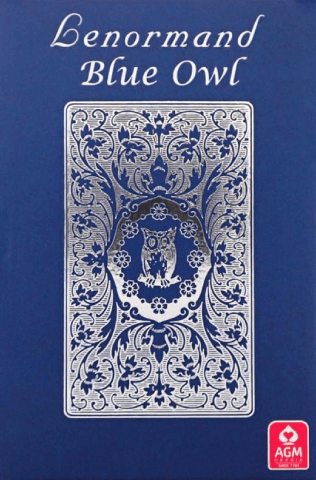
Its name comes from the card backs: a small blue owl printed
on a patterned blue field, easy to recognise the moment a
deck is opened. Inside, the cards themselves carry no
ornament beyond the symbol, the number, the inset playing
card, and a brief verse — and that is precisely the point.
The Artwork
The illustrations are flat, folk-art images on a soft
off-white field — the Rider on his horse, the Ship on its
waves, the Tree standing alone. The lines are simple, the
colours muted, and there is no painted background or
atmospheric staging. Each card is essentially a labelled
symbol, exactly the way Lenormand cards have looked since
they were printed as a children's parlour-game deck in the
early 1800s. Where modern art-Lenormand decks build scenes,
the Blue Owl shows you the noun and trusts you to read the
sentence.
Each card also carries a short verse — a four-line rhyme in
German on most editions, with English-language editions
translating the verses on the card itself or in the
accompanying booklet. The verses are part of the deck's
historical character, even if most modern readers don't
actively use them in their interpretations.
The 36 Cards
Strictly the traditional 36 — Rider, Clover, Ship, House, all
the way through to the Cross, in their classical numbering
and with the standard playing-card associations. There are no
extra cards, no alternative variants, no modern additions.
The deck is a clean baseline, and pairings, lines, and the
Grand Tableau all behave exactly as the books describe them.
Who It's For
The Blue Owl is the deck most often recommended to serious
students of Lenormand. If you want to learn the system the
way it has actually been read for over a century — to study
alongside Andrews, Treppner, or Pace, or to keep faith with
the European tradition — this is the deck that matches the
books. It's also the deck most German-speaking readers
actually use, so it has a near-canonical authority that
art-led decks can't quite claim.
It's a less obvious choice for readers who want their cards
to feel visually immersive. The imagery is plain
on purpose, and that plainness can feel stark next to a deck
like the Gilded Reverie. If
atmosphere matters to you, you may prefer pairing the Blue
Owl with a more ornate deck and using each for what it does
best — the Blue Owl for study, an art deck for daily pulls.
Where to Find It
Currently in print from AGM-Urania (sometimes branded under
Königsfurt-Urania) and widely stocked by metaphysical and
tarot retailers. It's one of the most affordable Lenormand
decks on the market — historically the deck of working
readers, priced accordingly. English-language editions are
easy to find online; German originals are equally easy to
source if you'd rather have the cards as their first readers
held them.
Deck Details
Publisher
AGM-Urania
Origin
19th-century Germany
Cards
36 · Standard
Tradition
Traditional · Petit Lenormand