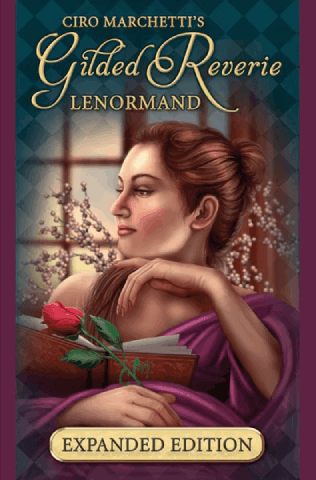
Modern Lenormand · By Ciro Marchetti
Gilded Reverie Lenormand
Modern
Digital art
Baroque
Jewel-toned
Expanded
A baroque, jewel-toned modern Lenormand by digital artist
Ciro Marchetti — the most beloved contemporary Lenormand
deck. Surreal, ornate, and unmistakably gilded.
About the Deck
The Gilded Reverie Lenormand is the work of Ciro Marchetti, a
digital artist already well-known to the tarot world for his
Tarot of Dreams and Legacy of the Divine. Released in 2013 by
U.S. Games Systems, it was one of the first widely-distributed
modern Lenormand decks to break with the small, plain
card-stock tradition and treat each of the 36 images as a full
piece of artwork. The deck is largely responsible for the wave
of modern, art-forward Lenormand decks that followed.
Two editions exist. The original 2013 release contains the
traditional 36 cards. The Expanded Edition, released a couple
of years later, adds a set of optional alternative cards —
new symbols Marchetti designed to give modern readers more
flexibility around questions of time, perspective, and
uncertainty. Most current copies sold today are the Expanded
Edition.
The Artwork
Marchetti's style is unmistakable: digital painting with
baroque ornament, deep jewel tones, soft golden light, and the
almost-photoreal quality that comes from working in 3D
composition before painting over it. Where traditional
Lenormand cards show a single object on a plain background,
the Gilded Reverie cards build whole scenes — the Bouquet
spills from a gilded vase under a chandelier, the Ship cuts
across a moonlit sea, the Tower looms behind iron gates. The
art is rich without being busy; the symbol is always central,
but the staging gives each card real atmosphere.
Each card has the traditional number and playing-card
association printed in the frame, so the deck reads
comfortably in any classical Lenormand layout — the artwork
adds depth without changing the system.
The 36 Cards (and the Extras)
The standard 36 are all there — Rider, Clover, Ship, House,
Tree, Clouds, all the way through to the Cross. The Expanded
Edition adds optional cards Marchetti felt the modern reader
could use: new images covering shades of meaning the
traditional 36 don't quite reach. Readers who like to keep
the system pure simply set those aside; readers who like to
experiment can deal them in.
Every traditional pairing — Heart + Ring, Anchor + Fish,
Clouds + Snake — works exactly as it would with any classical
deck. Combinations are still the heart of the reading.
Who It's For
The Gilded Reverie suits readers who want their Lenormand to
feel as visually substantial as their tarot. If you've come
to Lenormand from a tarot background and find the plain
German-style cards a little stark, this is usually the deck
that bridges the gap. It's also the deck most often
recommended to beginners — the imagery is evocative enough to
help newer readers actually feel the meaning of each
symbol while they learn the keywords.
Long-time traditionalists sometimes prefer a smaller, plainer
deck (the Blue Owl, the Piatnik, the Mlle Lenormand 1890) for
the historical feel. The Gilded Reverie isn't trying to be
that — it's the modern, ornamental cousin, and it earns its
place on its own terms.
Where to Find It
Currently published by U.S. Games Systems and stocked by most
metaphysical retailers, both online and in person. The
Expanded Edition is the version most widely available. Used
copies of the original 2013 first edition occasionally appear
on second-hand sites, sometimes at a premium.
Deck Details
Creator
Ciro Marchetti
Publisher
U.S. Games Systems
First Published
2013
Tradition
Modern · Petit Lenormand