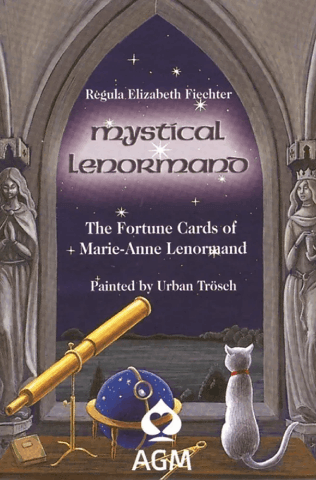
Mystical Lenormand
A cosmic, mystical, mildly metaphysical modern Lenormand by Regula Elizabeth Fiechter and Urban Trösch — a long-running AGM-Urania deck and a popular European working deck.
The Mystical Lenormand by Regula Elizabeth Fiechter (with imagery by Urban Trösch) is a long-running modern Lenormand favourite — first published by AGM-Urania in the early 2000s and still in steady print today. Where most modern decks lean either traditional-folk or art-painterly, the Mystical sits in a third category: cosmic, mystical, and mildly metaphysical, with imagery that draws on starscapes, light effects, and a quietly otherworldly sensibility.
It's the deck most often recommended to readers who want something contemporary but with a more spiritual register than the surreal Maybe Lenormand or the painterly Gilded Reverie.
Each card is a digital illustration with strong colour saturation, soft glow effects, and an emphasis on atmospheric staging. The Star is genuinely starry; the Moon is luminous; the Sun radiates. Even the more grounded cards (House, Tree, Anchor) carry a slightly heightened, slightly ethereal quality. The look is consistent across the deck and immediately recognisable.
The cards retain traditional numbering and playing-card associations, with both clearly visible on each card.
Readers drawn to a more spiritual register without abandoning the Lenormand system's practical directness. The Mystical Lenormand is also a popular working deck for European readers — its long publication history and wide distribution mean it sits on a lot of working readers' shelves.
If you've come to Lenormand with an interest in oracle decks, this deck bridges the two sensibilities comfortably.
Standard 36 in traditional numbering and playing-card associations. The reading conventions are entirely classical Lenormand; the mystical register is purely visual.
Published by AGM-Urania and continuously in print since the early 2000s. Widely available through European cartomancy retailers and online tarot shops, in multiple language editions.